How to Keep Your Kid Practicing Guitar Without the Daily Battle (5 Proven Tricks)
Thursday, February 5, 2026
You bought the guitar. Maybe you even scored a sweet deal at Guitar Center during their holiday sale. Your kid was pumped for exactly three weeks. Now? Getting them to practice feels like negotiating a hostage situation. "Just ten minutes!" you plead. They stare at the guitar case like it contains homework.
Here's the thing: you're not failing as a parent, and your kid isn't lazy. The problem is that traditional guitar practice is fundamentally broken for young learners. It's boring. It's repetitive. And for kids ages 6-13, it competes with YouTube, Roblox, and literally anything else that offers instant gratification.
But there are proven strategies to turn practice time from a daily argument into something your child actually looks forward to. Let's break down five tricks that actually work, no begging required.

1. Shrink Practice Time, Multiply the Days
Here's a radical idea: stop making your kid practice for an hour. In fact, forget 30 minutes. Research shows that 10-15 minutes of daily practice beats an hour-long session once a week, every single time.
Why? Because young fingers fatigue quickly. Attention spans are short. And when practice feels like a marathon, kids mentally check out before they even start. Daily consistency builds muscle memory, solidifies techniques, and creates a habit loop that doesn't require willpower.
Think of it like brushing teeth. You don't brush for 30 minutes on Sundays. You do two minutes every morning because it's routine, it's quick, and it doesn't feel like a big ask. Guitar practice should work the same way.
The trick: Set a timer for 10 minutes. When it goes off, practice ends, even if they're mid-song. This creates positive momentum. Your kid walks away thinking "that wasn't so bad" instead of feeling drained. Over time, many kids naturally extend practice because they want to finish what they started.
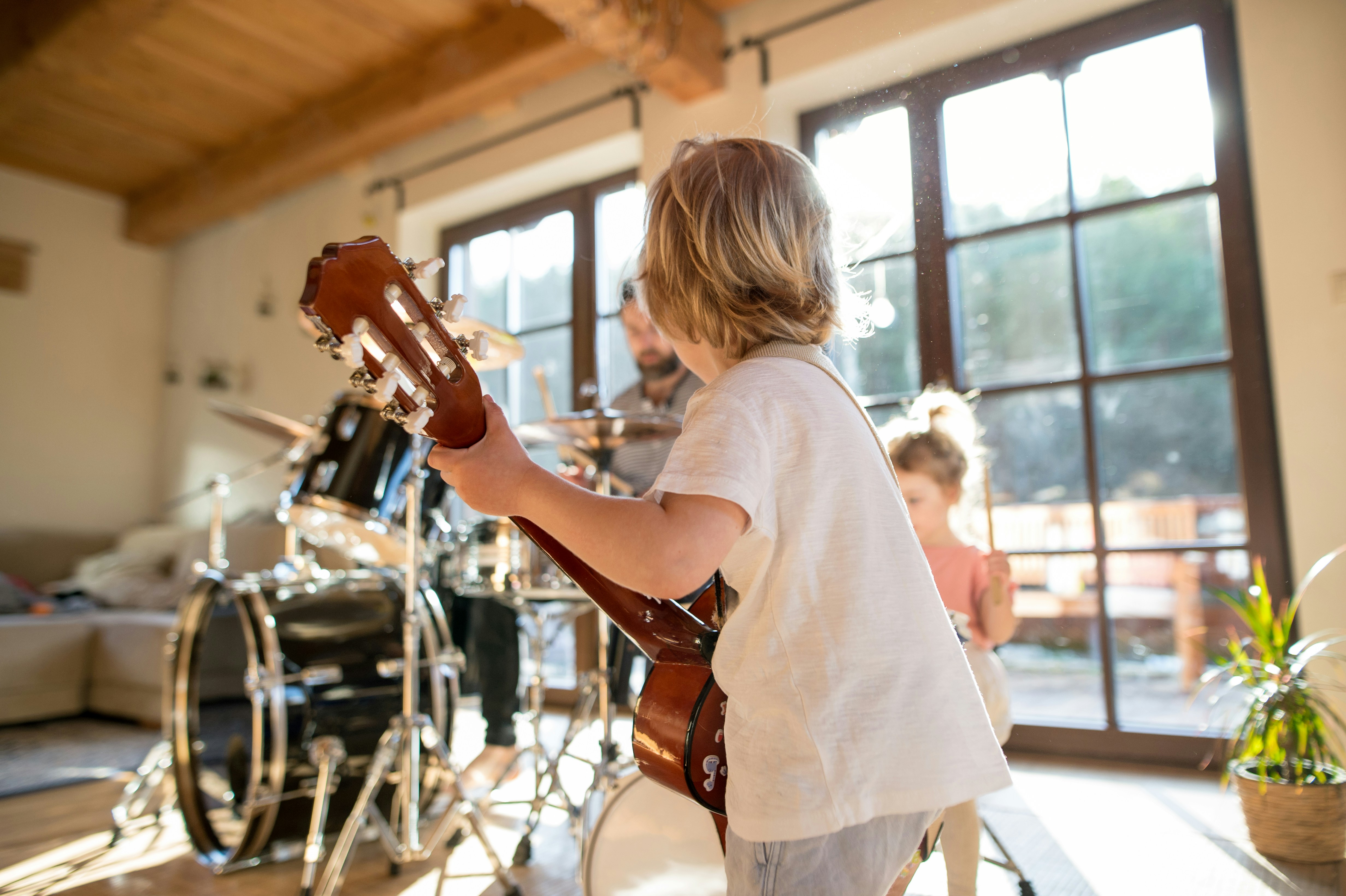
2. Turn Your Living Room Into Madison Square Garden
Kids don't practice in a vacuum. They need an audience. Hosting mini-concerts for family transforms practice from isolated drudgery into performance prep.
Here's how it works: Once a week (Sunday afternoon works great), your child performs 1-2 songs for whoever's home. Grandma on FaceTime counts. The dog counts. Make popcorn. Clap enthusiastically. Record it.
Why does this matter? Because suddenly, practice has purpose. They're not just strumming chords in their bedroom for abstract future benefits. They're rehearsing for a specific event where real people will watch and react.
This taps into something powerful: kids are natural performers. They want to show off what they can do. The mini-concert gives them a stage, and practice becomes the vehicle to nail that performance.
Bonus trick: Let them introduce each song like a real concert. "This next one is called 'Smoke on the Water,' and I learned it all by myself!" The storytelling adds another layer of engagement.
3. Let Them Play What They Actually Like
If your 10-year-old wants to learn the Encanto soundtrack instead of "Twinkle Twinkle Little Star," let them. This is non-negotiable.
Autonomy is the single most important factor in long-term motivation. When kids choose their own songs, practice stops feeling like an assignment and starts feeling like a mission. Yeah, "We Don't Talk About Bruno" might have tricky chord changes. That's fine. Struggling through a song they love teaches more than breezing through something they tolerate.
Too many guitar programs, whether it's apps like Simply Guitar, free lesson platforms like JustinGuitar, or traditional lesson books, force kids down a predetermined path of "beginner-friendly" songs that bore them to tears. The modern approach flips this: Start with what excites them, then teach the techniques needed to play it.
This is where a guitar learning app for kids becomes invaluable. The best ones let children pick songs from current pop hits, movie soundtracks, or video game themes, then adapt the difficulty on the fly. And if your kid wants a super straightforward way to explore songs outside of lessons, libraries like Pickup Music can help them chase a specific style or riff. When the technology meets kids where their interests already are, practice transforms into exploration.
4. Gamify Everything (Yes, Really)
Let's acknowledge the elephant in the room: your kid would rather play Fortnite than practice guitar. So what if guitar practice became the video game?
This isn't about "tricking" kids. It's about recognizing that gamification works because it provides immediate feedback, clear goals, and rewards for progression. These are exactly the elements traditional practice lacks.
Enter Notey's World: a video game for learning guitar that turns practice into boss battles. Your child plays a real guitar, and their performance determines whether they defeat the dragon or level up their character. Miss too many notes? The boss gets stronger. Nail that chord progression? Unlock new worlds.

Here's why this matters: When progress is invisible (like slowly improving finger strength), motivation dies. But when every practice session shows visual advancement: new abilities, completed levels, earned rewards: kids stay engaged. They're not thinking "I need to practice guitar." They're thinking "I need to beat this level."
This approach makes Notey's World fundamentally different from other guitar apps. It's not a tutorial with cartoons slapped on. It's a genuine music education app where gameplay mechanics and learning objectives are the same thing. Playing the game is practicing. Practicing is playing the game.
For parents sick of nagging, this is the secret weapon. Your kid reminds you it's time to practice because they want to see what happens next in the story.
5. Celebrate Small Wins (And Ditch the Criticism)
Here's a hard truth: your feedback style might be sabotaging progress. When practice ends with "that sounded better, but you're still making mistakes in measure three," kids hear criticism, not encouragement.
The no-nag approach works like this: Notice and celebrate specific improvements, no matter how small. "You hit that G chord clean three times in a row: that was tough last week!" This is infinitely more effective than vague praise ("good job") or backhand compliments ("not bad, but...").
Use a progress chart. Take videos. Compare recordings from a month ago. When kids see their improvement, they internalize the connection between effort and results. This builds intrinsic motivation: the kind that doesn't need parental enforcement.
The research backs this up: Positive reinforcement focused on effort (not just outcomes) creates resilient learners who persist through challenges. Kids who hear "you worked really hard on that transition" instead of "you're so talented" develop better practice habits long-term.
This is also where apps like Notey's World shine again. The game provides instant, objective feedback. They either hit the notes or they don't: and the game responds accordingly. There's no ambiguity, no parental judgment, just clear data about what's working.
The Bottom Line: Make Practice Feel Like Play
Guitar should be fun. If it's not, something's broken: and it's probably not your kid.
The five strategies above work because they address the real barriers to practice: lack of clear goals, missing autonomy, invisible progress, and the grind of repetition. When you shrink practice time, create performance opportunities, honor their musical preferences, gamify the experience, and celebrate every small win, you eliminate the friction that turns practice into a battle.
For parents ready to stop the daily arguments, a guitar app for beginners like Notey's World brings all five strategies together in one place. It enforces short, daily sessions. It lets kids choose songs they love. It gamifies every aspect of learning. And it celebrates progress automatically through level-ups and rewards.
Want to see the difference? Check out how Notey's World transforms guitar practice from obligation into obsession. Because when learning feels like playing, kids don't need reminders to practice. They need reminders to stop.
You bought the guitar. Maybe you even scored a sweet deal at Guitar Center during their holiday sale. Your kid was pumped for exactly three weeks. Now? Getting them to practice feels like negotiating a hostage situation. "Just ten minutes!" you plead. They stare at the guitar case like it contains homework.
Here's the thing: you're not failing as a parent, and your kid isn't lazy. The problem is that traditional guitar practice is fundamentally broken for young learners. It's boring. It's repetitive. And for kids ages 6-13, it competes with YouTube, Roblox, and literally anything else that offers instant gratification.
But there are proven strategies to turn practice time from a daily argument into something your child actually looks forward to. Let's break down five tricks that actually work, no begging required.

1. Shrink Practice Time, Multiply the Days
Here's a radical idea: stop making your kid practice for an hour. In fact, forget 30 minutes. Research shows that 10-15 minutes of daily practice beats an hour-long session once a week, every single time.
Why? Because young fingers fatigue quickly. Attention spans are short. And when practice feels like a marathon, kids mentally check out before they even start. Daily consistency builds muscle memory, solidifies techniques, and creates a habit loop that doesn't require willpower.
Think of it like brushing teeth. You don't brush for 30 minutes on Sundays. You do two minutes every morning because it's routine, it's quick, and it doesn't feel like a big ask. Guitar practice should work the same way.
The trick: Set a timer for 10 minutes. When it goes off, practice ends, even if they're mid-song. This creates positive momentum. Your kid walks away thinking "that wasn't so bad" instead of feeling drained. Over time, many kids naturally extend practice because they want to finish what they started.
2. Turn Your Living Room Into Madison Square Garden
Kids don't practice in a vacuum. They need an audience. Hosting mini-concerts for family transforms practice from isolated drudgery into performance prep.
Here's how it works: Once a week (Sunday afternoon works great), your child performs 1-2 songs for whoever's home. Grandma on FaceTime counts. The dog counts. Make popcorn. Clap enthusiastically. Record it.
Why does this matter? Because suddenly, practice has purpose. They're not just strumming chords in their bedroom for abstract future benefits. They're rehearsing for a specific event where real people will watch and react.
This taps into something powerful: kids are natural performers. They want to show off what they can do. The mini-concert gives them a stage, and practice becomes the vehicle to nail that performance.
Bonus trick: Let them introduce each song like a real concert. "This next one is called 'Smoke on the Water,' and I learned it all by myself!" The storytelling adds another layer of engagement.
3. Let Them Play What They Actually Like
If your 10-year-old wants to learn the Encanto soundtrack instead of "Twinkle Twinkle Little Star," let them. This is non-negotiable.
Autonomy is the single most important factor in long-term motivation. When kids choose their own songs, practice stops feeling like an assignment and starts feeling like a mission. Yeah, "We Don't Talk About Bruno" might have tricky chord changes. That's fine. Struggling through a song they love teaches more than breezing through something they tolerate.
Too many guitar programs, whether it's apps like Simply Guitar, free lesson platforms like JustinGuitar, or traditional lesson books, force kids down a predetermined path of "beginner-friendly" songs that bore them to tears. The modern approach flips this: Start with what excites them, then teach the techniques needed to play it.
This is where a guitar learning app for kids becomes invaluable. The best ones let children pick songs from current pop hits, movie soundtracks, or video game themes, then adapt the difficulty on the fly. And if your kid wants a super straightforward way to explore songs outside of lessons, libraries like Pickup Music can help them chase a specific style or riff. When the technology meets kids where their interests already are, practice transforms into exploration.
4. Gamify Everything (Yes, Really)
Let's acknowledge the elephant in the room: your kid would rather play Fortnite than practice guitar. So what if guitar practice became the video game?
This isn't about "tricking" kids. It's about recognizing that gamification works because it provides immediate feedback, clear goals, and rewards for progression. These are exactly the elements traditional practice lacks.
Enter Notey's World: a video game for learning guitar that turns practice into boss battles. Your child plays a real guitar, and their performance determines whether they defeat the dragon or level up their character. Miss too many notes? The boss gets stronger. Nail that chord progression? Unlock new worlds.

Here's why this matters: When progress is invisible (like slowly improving finger strength), motivation dies. But when every practice session shows visual advancement: new abilities, completed levels, earned rewards: kids stay engaged. They're not thinking "I need to practice guitar." They're thinking "I need to beat this level."
This approach makes Notey's World fundamentally different from other guitar apps. It's not a tutorial with cartoons slapped on. It's a genuine music education app where gameplay mechanics and learning objectives are the same thing. Playing the game is practicing. Practicing is playing the game.
For parents sick of nagging, this is the secret weapon. Your kid reminds you it's time to practice because they want to see what happens next in the story.
5. Celebrate Small Wins (And Ditch the Criticism)
Here's a hard truth: your feedback style might be sabotaging progress. When practice ends with "that sounded better, but you're still making mistakes in measure three," kids hear criticism, not encouragement.
The no-nag approach works like this: Notice and celebrate specific improvements, no matter how small. "You hit that G chord clean three times in a row: that was tough last week!" This is infinitely more effective than vague praise ("good job") or backhand compliments ("not bad, but...").
Use a progress chart. Take videos. Compare recordings from a month ago. When kids see their improvement, they internalize the connection between effort and results. This builds intrinsic motivation: the kind that doesn't need parental enforcement.
The research backs this up: Positive reinforcement focused on effort (not just outcomes) creates resilient learners who persist through challenges. Kids who hear "you worked really hard on that transition" instead of "you're so talented" develop better practice habits long-term.
This is also where apps like Notey's World shine again. The game provides instant, objective feedback. They either hit the notes or they don't: and the game responds accordingly. There's no ambiguity, no parental judgment, just clear data about what's working.
The Bottom Line: Make Practice Feel Like Play
Guitar should be fun. If it's not, something's broken: and it's probably not your kid.
The five strategies above work because they address the real barriers to practice: lack of clear goals, missing autonomy, invisible progress, and the grind of repetition. When you shrink practice time, create performance opportunities, honor their musical preferences, gamify the experience, and celebrate every small win, you eliminate the friction that turns practice into a battle.
For parents ready to stop the daily arguments, a guitar app for beginners like Notey's World brings all five strategies together in one place. It enforces short, daily sessions. It lets kids choose songs they love. It gamifies every aspect of learning. And it celebrates progress automatically through level-ups and rewards.
Want to see the difference? Check out how Notey's World transforms guitar practice from obligation into obsession. Because when learning feels like playing, kids don't need reminders to practice. They need reminders to stop.
You bought the guitar. Maybe you even scored a sweet deal at Guitar Center during their holiday sale. Your kid was pumped for exactly three weeks. Now? Getting them to practice feels like negotiating a hostage situation. "Just ten minutes!" you plead. They stare at the guitar case like it contains homework.
Here's the thing: you're not failing as a parent, and your kid isn't lazy. The problem is that traditional guitar practice is fundamentally broken for young learners. It's boring. It's repetitive. And for kids ages 6-13, it competes with YouTube, Roblox, and literally anything else that offers instant gratification.
But there are proven strategies to turn practice time from a daily argument into something your child actually looks forward to. Let's break down five tricks that actually work, no begging required.

1. Shrink Practice Time, Multiply the Days
Here's a radical idea: stop making your kid practice for an hour. In fact, forget 30 minutes. Research shows that 10-15 minutes of daily practice beats an hour-long session once a week, every single time.
Why? Because young fingers fatigue quickly. Attention spans are short. And when practice feels like a marathon, kids mentally check out before they even start. Daily consistency builds muscle memory, solidifies techniques, and creates a habit loop that doesn't require willpower.
Think of it like brushing teeth. You don't brush for 30 minutes on Sundays. You do two minutes every morning because it's routine, it's quick, and it doesn't feel like a big ask. Guitar practice should work the same way.
The trick: Set a timer for 10 minutes. When it goes off, practice ends, even if they're mid-song. This creates positive momentum. Your kid walks away thinking "that wasn't so bad" instead of feeling drained. Over time, many kids naturally extend practice because they want to finish what they started.
2. Turn Your Living Room Into Madison Square Garden
Kids don't practice in a vacuum. They need an audience. Hosting mini-concerts for family transforms practice from isolated drudgery into performance prep.
Here's how it works: Once a week (Sunday afternoon works great), your child performs 1-2 songs for whoever's home. Grandma on FaceTime counts. The dog counts. Make popcorn. Clap enthusiastically. Record it.
Why does this matter? Because suddenly, practice has purpose. They're not just strumming chords in their bedroom for abstract future benefits. They're rehearsing for a specific event where real people will watch and react.
This taps into something powerful: kids are natural performers. They want to show off what they can do. The mini-concert gives them a stage, and practice becomes the vehicle to nail that performance.
Bonus trick: Let them introduce each song like a real concert. "This next one is called 'Smoke on the Water,' and I learned it all by myself!" The storytelling adds another layer of engagement.
3. Let Them Play What They Actually Like
If your 10-year-old wants to learn the Encanto soundtrack instead of "Twinkle Twinkle Little Star," let them. This is non-negotiable.
Autonomy is the single most important factor in long-term motivation. When kids choose their own songs, practice stops feeling like an assignment and starts feeling like a mission. Yeah, "We Don't Talk About Bruno" might have tricky chord changes. That's fine. Struggling through a song they love teaches more than breezing through something they tolerate.
Too many guitar programs, whether it's apps like Simply Guitar, free lesson platforms like JustinGuitar, or traditional lesson books, force kids down a predetermined path of "beginner-friendly" songs that bore them to tears. The modern approach flips this: Start with what excites them, then teach the techniques needed to play it.
This is where a guitar learning app for kids becomes invaluable. The best ones let children pick songs from current pop hits, movie soundtracks, or video game themes, then adapt the difficulty on the fly. And if your kid wants a super straightforward way to explore songs outside of lessons, libraries like Pickup Music can help them chase a specific style or riff. When the technology meets kids where their interests already are, practice transforms into exploration.
4. Gamify Everything (Yes, Really)
Let's acknowledge the elephant in the room: your kid would rather play Fortnite than practice guitar. So what if guitar practice became the video game?
This isn't about "tricking" kids. It's about recognizing that gamification works because it provides immediate feedback, clear goals, and rewards for progression. These are exactly the elements traditional practice lacks.
Enter Notey's World: a video game for learning guitar that turns practice into boss battles. Your child plays a real guitar, and their performance determines whether they defeat the dragon or level up their character. Miss too many notes? The boss gets stronger. Nail that chord progression? Unlock new worlds.

Here's why this matters: When progress is invisible (like slowly improving finger strength), motivation dies. But when every practice session shows visual advancement: new abilities, completed levels, earned rewards: kids stay engaged. They're not thinking "I need to practice guitar." They're thinking "I need to beat this level."
This approach makes Notey's World fundamentally different from other guitar apps. It's not a tutorial with cartoons slapped on. It's a genuine music education app where gameplay mechanics and learning objectives are the same thing. Playing the game is practicing. Practicing is playing the game.
For parents sick of nagging, this is the secret weapon. Your kid reminds you it's time to practice because they want to see what happens next in the story.
5. Celebrate Small Wins (And Ditch the Criticism)
Here's a hard truth: your feedback style might be sabotaging progress. When practice ends with "that sounded better, but you're still making mistakes in measure three," kids hear criticism, not encouragement.
The no-nag approach works like this: Notice and celebrate specific improvements, no matter how small. "You hit that G chord clean three times in a row: that was tough last week!" This is infinitely more effective than vague praise ("good job") or backhand compliments ("not bad, but...").
Use a progress chart. Take videos. Compare recordings from a month ago. When kids see their improvement, they internalize the connection between effort and results. This builds intrinsic motivation: the kind that doesn't need parental enforcement.
The research backs this up: Positive reinforcement focused on effort (not just outcomes) creates resilient learners who persist through challenges. Kids who hear "you worked really hard on that transition" instead of "you're so talented" develop better practice habits long-term.
This is also where apps like Notey's World shine again. The game provides instant, objective feedback. They either hit the notes or they don't: and the game responds accordingly. There's no ambiguity, no parental judgment, just clear data about what's working.
The Bottom Line: Make Practice Feel Like Play
Guitar should be fun. If it's not, something's broken: and it's probably not your kid.
The five strategies above work because they address the real barriers to practice: lack of clear goals, missing autonomy, invisible progress, and the grind of repetition. When you shrink practice time, create performance opportunities, honor their musical preferences, gamify the experience, and celebrate every small win, you eliminate the friction that turns practice into a battle.
For parents ready to stop the daily arguments, a guitar app for beginners like Notey's World brings all five strategies together in one place. It enforces short, daily sessions. It lets kids choose songs they love. It gamifies every aspect of learning. And it celebrates progress automatically through level-ups and rewards.
Want to see the difference? Check out how Notey's World transforms guitar practice from obligation into obsession. Because when learning feels like playing, kids don't need reminders to practice. They need reminders to stop.
