Sight Reading on Guitar 101: A Beginner's Guide to Finally Understanding Notes

Monday, January 26, 2026
Learning to play guitar is exciting, until someone puts a new sheet music and tab in front of you. Suddenly, all those lines, notes, and numbers look like a secret code no one taught you to crack. If your kid (or you!) has ever stared blankly at written music while holding a guitar, you're not alone. Ever heard of this common joke:
How do you get a guitar player to stop playing? Put a sheet of music in front of them.
Sight reading is one of the most valuable skills any musician can develop. It's also one of the most skipped. Why? Because traditional methods make it feel like homework. But here's the good news: sight reading doesn't have to be boring, confusing, or frustrating. With the right approach, and a little help from a music education app that turns practice into play, anyone can learn to read music and actually enjoy the process.
Let's break it down and silence the joke.
What Is Sight Reading, Anyway?
Sight reading is exactly what it sounds like: reading and playing a piece of music you've never seen before, in real time. No practice runs. No memorization. Just you, the page, and your instrument.
Think of it like reading a book out loud for the first time. You're processing words (or in this case, notes) while simultaneously performing them. It's a skill that takes coordination, focus, and practice, but once you've got it, you unlock a whole new world of musical possibilities.
For guitar players, sight reading means:
Recognizing notes on the staff and knowing where they live on the fretboard
Understanding rhythm so you play the right notes at the right time
Keeping your eyes moving forward while your fingers catch up
It's challenging. But it's also incredibly rewarding.
Why Is Sight Reading So Hard for Beginners?
Let's be honest: most kids (and adults) find sight reading frustrating at first. There are a few reasons for this.
1. The guitar fretboard is a maze and three-dimensional
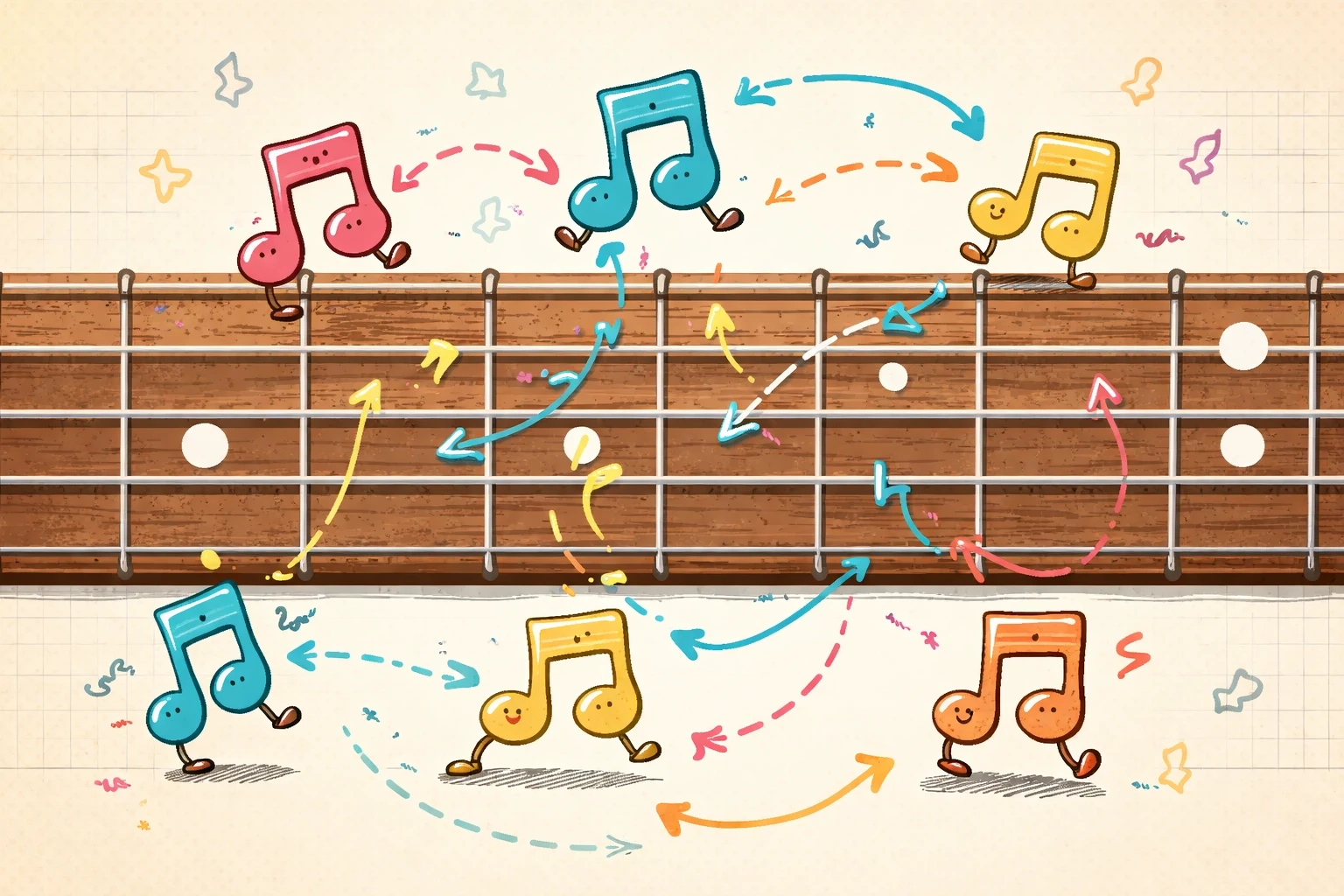
Unlike piano, where each key plays one note, the guitar has the same note in multiple places. An E? It exists on at least three different strings. This makes connecting what you see on paper to what you play on the guitar way more complicated.
2. Traditional methods are... dry
Flashcards. Worksheets. Repetitive exercises with zero context. Most sight reading instruction feels like studying for a test rather than making music. For kids especially, this approach kills motivation fast.
3. There's no immediate reward
When you're learning a song by ear or watching a YouTube tutorial, you hear progress quickly. With sight reading, the payoff takes longer, and without encouragement, it's easy to give up.
4. It requires multiple skills at once
Sight reading isn't just about knowing notes. It's about rhythm, flexible hand-eye coordination, and musical instincts all happening simultaneously. That's a lot to juggle, especially for beginners.
The result? Many guitar learners skip sight reading altogether and rely only on tabs or memorization. But that limits how far they can go.
The Core Components of Sight Reading Guitar
Before diving into practice tips, let's look at what you're actually building when you learn to sight read:
Pitch Recognition: Identifying notes on the staff and finding them on your fretboard without hesitation
Rhythm Interpretation: Understanding note values (whole notes, half notes, quarter notes) and how they fit into a beat
Hand-Eye Coordination: Reading ahead while your fingers execute what you just read
Musical Context Awareness: Recognizing key signatures, time signatures, dynamics, and other markings that shape how the music sounds
Here's a pro tip that changes everything: your eyes should always be ahead of your fingers. While you're playing one measure, you should already be reading the next. This mental preparation is what separates slow, hesitant playing from smooth, confident sight reading.
Practical Tips for Learning Sight Reading on Guitar
Ready to get started? Here's how to build your sight reading skills without losing your mind (or your motivation).
Start Small, Really Small
Begin with the open strings and notes in the first three frets. Use simple rhythms like whole notes and half notes. The goal isn't to play complicated music right away, it's to build a solid foundation you can expand on.
Read in Chunks, Not Individual Notes
Instead of reading one note at a time, try to see patterns. Music is full of scales, arpeggios, and repeated phrases. When you recognize a familiar shape, you can play it almost automatically. This speeds up reading and makes everything feel less overwhelming.
Practice Away from Your Guitar
Seriously. Take some sheet music with you and tap out the rhythms on your leg. Hum the pitches. Trace the melody with your finger. This kind of mental practice helps your brain internalize patterns so you're ready when you pick up the instrument.
Master Key Signatures Early
Before you play anything, look at the key signature. Are there sharps? Flats? Knowing this upfront means you won't be surprised mid-song. Practice scales in different keys so they become second nature.
Keep the Pulse Moving
When you hit a tricky section, don't stop. Even if you have to simplify, playing just the first note of each group or sticking to the bass line, keep the rhythm going. Maintaining a steady pulse trains you to recover from mistakes without losing your place.
Make It a Daily Habit
Even five minutes of sight reading practice each day makes a huge difference. Your brain builds connections through repetition, and consistent short sessions beat occasional long ones every time. (Speaking of repetition, check out our post on why repetition is the most important skill in learning guitar.)
Why Traditional Methods Fall Short for Kids
Here's where things get real. Traditional sight reading instruction was designed for music schools and conservatories, not for a 9-year-old who'd rather be playing video games and have more fun with the instrument.
Worksheets and drills don't hold attention: they feel like punishment. And when progress is slow and invisible, kids check out.
That doesn't mean sight reading is impossible for young learners. It means we need a better approach. One that meets kids where they are, inside a game.
How Notey's World Turns Sight Reading Into an Adventure
This is where a guitar app for beginners like Notey's World changes everything.
Instead of staring at boring exercises, kids explore musical universes where reading notes is part of the adventure. Every correct note moves them forward. Every rhythm they nail unlocks new challenges. The app uses real guitar input, so they're building actual skills, not just tapping a screen.
Here's what makes Notey's World different:
Gamified Learning: Progress through levels, earn rewards, and unlock new worlds. Sight reading becomes something kids want to do.
Real-Time Feedback: The app listens to what you play and responds instantly. No guessing if you got it right.
Adaptive Difficulty: Start simple and level up as your skills grow. The app meets you where you are.
Engaging Storylines: Music isn't just notes on a page, it's the key to adventure. Kids stay motivated because they're invested in the journey.
The result? Kids actually practice. They build sight reading skills without even realizing they're "studying." And parents get to skip the daily battle over practice time.
If you're curious about how the technology works, our team wrote a deep dive on the audio engine behind Notey's World.
Sight Reading Is a Superpower, And It's Within Reach
Learning to sight read guitar opens doors. It means you can pick up any piece of music and play it. Join a band without needing weeks to learn new songs. Communicate with other musicians in a universal language.
Yes, it takes practice. Yes, it can feel hard at first. But with the right tools and a little patience, anyone can learn to sight read: even kids who swear they hate reading music.
The key is making it fun. Making it feel like progress. Making it something worth coming back to every day.
That's exactly what a great music education app should do. And that's exactly what we built Notey's World to be.
Ready to turn sight reading from a chore into an adventure? Check out Notey's World and see how gamified guitar learning can transform practice time for beginners of all ages.
Learning to play guitar is exciting, until someone puts a new sheet music and tab in front of you. Suddenly, all those lines, notes, and numbers look like a secret code no one taught you to crack. If your kid (or you!) has ever stared blankly at written music while holding a guitar, you're not alone. Ever heard of this common joke:
How do you get a guitar player to stop playing? Put a sheet of music in front of them.
Sight reading is one of the most valuable skills any musician can develop. It's also one of the most skipped. Why? Because traditional methods make it feel like homework. But here's the good news: sight reading doesn't have to be boring, confusing, or frustrating. With the right approach, and a little help from a music education app that turns practice into play, anyone can learn to read music and actually enjoy the process.
Let's break it down and silence the joke.
What Is Sight Reading, Anyway?
Sight reading is exactly what it sounds like: reading and playing a piece of music you've never seen before, in real time. No practice runs. No memorization. Just you, the page, and your instrument.
Think of it like reading a book out loud for the first time. You're processing words (or in this case, notes) while simultaneously performing them. It's a skill that takes coordination, focus, and practice, but once you've got it, you unlock a whole new world of musical possibilities.
For guitar players, sight reading means:
Recognizing notes on the staff and knowing where they live on the fretboard
Understanding rhythm so you play the right notes at the right time
Keeping your eyes moving forward while your fingers catch up
It's challenging. But it's also incredibly rewarding.
Why Is Sight Reading So Hard for Beginners?
Let's be honest: most kids (and adults) find sight reading frustrating at first. There are a few reasons for this.
1. The guitar fretboard is a maze and three-dimensional
Unlike piano, where each key plays one note, the guitar has the same note in multiple places. An E? It exists on at least three different strings. This makes connecting what you see on paper to what you play on the guitar way more complicated.
2. Traditional methods are... dry
Flashcards. Worksheets. Repetitive exercises with zero context. Most sight reading instruction feels like studying for a test rather than making music. For kids especially, this approach kills motivation fast.
3. There's no immediate reward
When you're learning a song by ear or watching a YouTube tutorial, you hear progress quickly. With sight reading, the payoff takes longer, and without encouragement, it's easy to give up.
4. It requires multiple skills at once
Sight reading isn't just about knowing notes. It's about rhythm, flexible hand-eye coordination, and musical instincts all happening simultaneously. That's a lot to juggle, especially for beginners.
The result? Many guitar learners skip sight reading altogether and rely only on tabs or memorization. But that limits how far they can go.
The Core Components of Sight Reading Guitar
Before diving into practice tips, let's look at what you're actually building when you learn to sight read:
Pitch Recognition: Identifying notes on the staff and finding them on your fretboard without hesitation
Rhythm Interpretation: Understanding note values (whole notes, half notes, quarter notes) and how they fit into a beat
Hand-Eye Coordination: Reading ahead while your fingers execute what you just read
Musical Context Awareness: Recognizing key signatures, time signatures, dynamics, and other markings that shape how the music sounds
Here's a pro tip that changes everything: your eyes should always be ahead of your fingers. While you're playing one measure, you should already be reading the next. This mental preparation is what separates slow, hesitant playing from smooth, confident sight reading.

Practical Tips for Learning Sight Reading on Guitar
Ready to get started? Here's how to build your sight reading skills without losing your mind (or your motivation).
Start Small, Really Small
Begin with the open strings and notes in the first three frets. Use simple rhythms like whole notes and half notes. The goal isn't to play complicated music right away, it's to build a solid foundation you can expand on.
Read in Chunks, Not Individual Notes
Instead of reading one note at a time, try to see patterns. Music is full of scales, arpeggios, and repeated phrases. When you recognize a familiar shape, you can play it almost automatically. This speeds up reading and makes everything feel less overwhelming.
Practice Away from Your Guitar
Seriously. Take some sheet music with you and tap out the rhythms on your leg. Hum the pitches. Trace the melody with your finger. This kind of mental practice helps your brain internalize patterns so you're ready when you pick up the instrument.
Master Key Signatures Early
Before you play anything, look at the key signature. Are there sharps? Flats? Knowing this upfront means you won't be surprised mid-song. Practice scales in different keys so they become second nature.
Keep the Pulse Moving
When you hit a tricky section, don't stop. Even if you have to simplify, playing just the first note of each group or sticking to the bass line, keep the rhythm going. Maintaining a steady pulse trains you to recover from mistakes without losing your place.
Make It a Daily Habit
Even five minutes of sight reading practice each day makes a huge difference. Your brain builds connections through repetition, and consistent short sessions beat occasional long ones every time. (Speaking of repetition, check out our post on why repetition is the most important skill in learning guitar.)
Why Traditional Methods Fall Short for Kids
Here's where things get real. Traditional sight reading instruction was designed for music schools and conservatories, not for a 9-year-old who'd rather be playing video games and have more fun with the instrument.
Worksheets and drills don't hold attention: they feel like punishment. And when progress is slow and invisible, kids check out.
That doesn't mean sight reading is impossible for young learners. It means we need a better approach. One that meets kids where they are, inside a game.
How Notey's World Turns Sight Reading Into an Adventure
This is where a guitar app for beginners like Notey's World changes everything.
Instead of staring at boring exercises, kids explore musical universes where reading notes is part of the adventure. Every correct note moves them forward. Every rhythm they nail unlocks new challenges. The app uses real guitar input, so they're building actual skills, not just tapping a screen.
Here's what makes Notey's World different:
Gamified Learning: Progress through levels, earn rewards, and unlock new worlds. Sight reading becomes something kids want to do.
Real-Time Feedback: The app listens to what you play and responds instantly. No guessing if you got it right.
Adaptive Difficulty: Start simple and level up as your skills grow. The app meets you where you are.
Engaging Storylines: Music isn't just notes on a page, it's the key to adventure. Kids stay motivated because they're invested in the journey.
The result? Kids actually practice. They build sight reading skills without even realizing they're "studying." And parents get to skip the daily battle over practice time.
If you're curious about how the technology works, our team wrote a deep dive on the audio engine behind Notey's World.
Sight Reading Is a Superpower, And It's Within Reach
Learning to sight read guitar opens doors. It means you can pick up any piece of music and play it. Join a band without needing weeks to learn new songs. Communicate with other musicians in a universal language.
Yes, it takes practice. Yes, it can feel hard at first. But with the right tools and a little patience, anyone can learn to sight read: even kids who swear they hate reading music.
The key is making it fun. Making it feel like progress. Making it something worth coming back to every day.
That's exactly what a great music education app should do. And that's exactly what we built Notey's World to be.
Ready to turn sight reading from a chore into an adventure? Check out Notey's World and see how gamified guitar learning can transform practice time for beginners of all ages.
Learning to play guitar is exciting, until someone puts a new sheet music and tab in front of you. Suddenly, all those lines, notes, and numbers look like a secret code no one taught you to crack. If your kid (or you!) has ever stared blankly at written music while holding a guitar, you're not alone. Ever heard of this common joke:
How do you get a guitar player to stop playing? Put a sheet of music in front of them.
Sight reading is one of the most valuable skills any musician can develop. It's also one of the most skipped. Why? Because traditional methods make it feel like homework. But here's the good news: sight reading doesn't have to be boring, confusing, or frustrating. With the right approach, and a little help from a music education app that turns practice into play, anyone can learn to read music and actually enjoy the process.
Let's break it down and silence the joke.
What Is Sight Reading, Anyway?
Sight reading is exactly what it sounds like: reading and playing a piece of music you've never seen before, in real time. No practice runs. No memorization. Just you, the page, and your instrument.
Think of it like reading a book out loud for the first time. You're processing words (or in this case, notes) while simultaneously performing them. It's a skill that takes coordination, focus, and practice, but once you've got it, you unlock a whole new world of musical possibilities.
For guitar players, sight reading means:
Recognizing notes on the staff and knowing where they live on the fretboard
Understanding rhythm so you play the right notes at the right time
Keeping your eyes moving forward while your fingers catch up
It's challenging. But it's also incredibly rewarding.
Why Is Sight Reading So Hard for Beginners?
Let's be honest: most kids (and adults) find sight reading frustrating at first. There are a few reasons for this.
1. The guitar fretboard is a maze and three-dimensional
Unlike piano, where each key plays one note, the guitar has the same note in multiple places. An E? It exists on at least three different strings. This makes connecting what you see on paper to what you play on the guitar way more complicated.
2. Traditional methods are... dry
Flashcards. Worksheets. Repetitive exercises with zero context. Most sight reading instruction feels like studying for a test rather than making music. For kids especially, this approach kills motivation fast.
3. There's no immediate reward
When you're learning a song by ear or watching a YouTube tutorial, you hear progress quickly. With sight reading, the payoff takes longer, and without encouragement, it's easy to give up.
4. It requires multiple skills at once
Sight reading isn't just about knowing notes. It's about rhythm, flexible hand-eye coordination, and musical instincts all happening simultaneously. That's a lot to juggle, especially for beginners.
The result? Many guitar learners skip sight reading altogether and rely only on tabs or memorization. But that limits how far they can go.
The Core Components of Sight Reading Guitar
Before diving into practice tips, let's look at what you're actually building when you learn to sight read:
Pitch Recognition: Identifying notes on the staff and finding them on your fretboard without hesitation
Rhythm Interpretation: Understanding note values (whole notes, half notes, quarter notes) and how they fit into a beat
Hand-Eye Coordination: Reading ahead while your fingers execute what you just read
Musical Context Awareness: Recognizing key signatures, time signatures, dynamics, and other markings that shape how the music sounds
Here's a pro tip that changes everything: your eyes should always be ahead of your fingers. While you're playing one measure, you should already be reading the next. This mental preparation is what separates slow, hesitant playing from smooth, confident sight reading.

Practical Tips for Learning Sight Reading on Guitar
Ready to get started? Here's how to build your sight reading skills without losing your mind (or your motivation).
Start Small, Really Small
Begin with the open strings and notes in the first three frets. Use simple rhythms like whole notes and half notes. The goal isn't to play complicated music right away, it's to build a solid foundation you can expand on.
Read in Chunks, Not Individual Notes
Instead of reading one note at a time, try to see patterns. Music is full of scales, arpeggios, and repeated phrases. When you recognize a familiar shape, you can play it almost automatically. This speeds up reading and makes everything feel less overwhelming.
Practice Away from Your Guitar
Seriously. Take some sheet music with you and tap out the rhythms on your leg. Hum the pitches. Trace the melody with your finger. This kind of mental practice helps your brain internalize patterns so you're ready when you pick up the instrument.
Master Key Signatures Early
Before you play anything, look at the key signature. Are there sharps? Flats? Knowing this upfront means you won't be surprised mid-song. Practice scales in different keys so they become second nature.
Keep the Pulse Moving
When you hit a tricky section, don't stop. Even if you have to simplify, playing just the first note of each group or sticking to the bass line, keep the rhythm going. Maintaining a steady pulse trains you to recover from mistakes without losing your place.
Make It a Daily Habit
Even five minutes of sight reading practice each day makes a huge difference. Your brain builds connections through repetition, and consistent short sessions beat occasional long ones every time. (Speaking of repetition, check out our post on why repetition is the most important skill in learning guitar.)
Why Traditional Methods Fall Short for Kids
Here's where things get real. Traditional sight reading instruction was designed for music schools and conservatories, not for a 9-year-old who'd rather be playing video games and have more fun with the instrument.
Worksheets and drills don't hold attention: they feel like punishment. And when progress is slow and invisible, kids check out.
That doesn't mean sight reading is impossible for young learners. It means we need a better approach. One that meets kids where they are, inside a game.
How Notey's World Turns Sight Reading Into an Adventure
This is where a guitar app for beginners like Notey's World changes everything.
Instead of staring at boring exercises, kids explore musical universes where reading notes is part of the adventure. Every correct note moves them forward. Every rhythm they nail unlocks new challenges. The app uses real guitar input, so they're building actual skills, not just tapping a screen.
Here's what makes Notey's World different:
Gamified Learning: Progress through levels, earn rewards, and unlock new worlds. Sight reading becomes something kids want to do.
Real-Time Feedback: The app listens to what you play and responds instantly. No guessing if you got it right.
Adaptive Difficulty: Start simple and level up as your skills grow. The app meets you where you are.
Engaging Storylines: Music isn't just notes on a page, it's the key to adventure. Kids stay motivated because they're invested in the journey.
The result? Kids actually practice. They build sight reading skills without even realizing they're "studying." And parents get to skip the daily battle over practice time.
If you're curious about how the technology works, our team wrote a deep dive on the audio engine behind Notey's World.
Sight Reading Is a Superpower, And It's Within Reach
Learning to sight read guitar opens doors. It means you can pick up any piece of music and play it. Join a band without needing weeks to learn new songs. Communicate with other musicians in a universal language.
Yes, it takes practice. Yes, it can feel hard at first. But with the right tools and a little patience, anyone can learn to sight read: even kids who swear they hate reading music.
The key is making it fun. Making it feel like progress. Making it something worth coming back to every day.
That's exactly what a great music education app should do. And that's exactly what we built Notey's World to be.
Ready to turn sight reading from a chore into an adventure? Check out Notey's World and see how gamified guitar learning can transform practice time for beginners of all ages.
