Video Game for Learning Guitar vs. Traditional Lessons: Which Actually Works for Your Kid?
Saturday, January 24, 2026
You've probably been there. Your kid begs for guitar lessons, you shell out the money, and three months later the guitar is gathering dust in the corner. Meanwhile, they'll happily spend hours glued to a screen playing video games.
So when you hear about a video game for learning guitar, it sounds almost too good to be true. Could your kid actually learn real guitar skills while having fun beating bosses in a game? Or is this just another gimmick that'll leave them button-mashing without learning a single chord?
Let's break down traditional guitar lessons versus gamified learning, and figure out which approach actually works for your kid.
The Traditional Route: Guitar Lessons for Kids
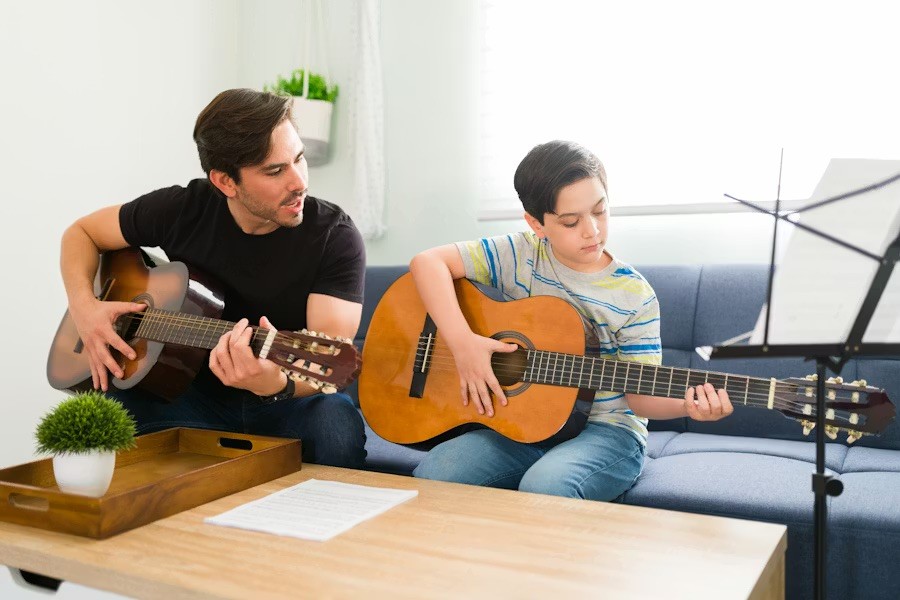
Traditional guitar lessons have been the gold standard for decades. There's a reason for that. A skilled instructor can provide personalized feedback, correct bad habits before they stick, and guide your child through a structured curriculum that builds real musical skills.
Here's what traditional lessons typically offer:
One-on-one attention from an experienced teacher
Technique correction for proper finger placement and hand positioning
Music theory foundations including reading sheet music
Accountability through weekly lessons and assigned practice
Social connection with a mentor figure
The benefits go beyond just learning guitar. Studies show that learning an instrument helps kids develop discipline, delayed gratification, and executive function. Managing the short-term discomfort of practice for long-term rewards builds self-control that translates to other areas of life.
Sounds great, right? So why do so many kids quit?

The Practice Problem
Here's the uncomfortable truth: traditional lessons only work if your kid actually practices between sessions.
And practice is where everything falls apart.
Most traditional guitar instruction requires 20-30 minutes of daily practice. For many kids, that feels like homework. It's repetitive. It's frustrating when progress feels slow. And let's be honest, it can't compete with the instant gratification of video games, social media, or YouTube.
The result? Parents pay for weekly lessons while their child's skills barely progress because the at-home practice never happens. According to research, repetition is the most important skill in learning guitar, and it's exactly what beginners tend to skip. (We wrote about this here.)
Traditional lessons assume motivation. But motivation is exactly what many kids are missing.
Enter the Video Game Approach
This is where games come in. Kids don't need motivation to play video games, the games are designed to be engaging. They use instant feedback, rewards, progression systems, and challenges to keep players coming back.
Music video games like Guitar Hero and Rock Band have been around for years, and they do help with certain skills. Research from the University of Nevada found that players of these games outperformed non-musicians in musical listening skills, including perception of melody, tuning, tempo, and rhythm.
But here's the catch: pressing colored buttons in time with music isn't the same as playing guitar.
Traditional music video games teach a simplified version of music. They don't cover chords, scales, or proper technique. Many kids who excel at Guitar Hero become discouraged when they pick up a real guitar and discover it's significantly harder than they expected.
So video games alone aren't the answer either.
The Real Question: Can a Video Game Teach Actual Guitar?
Here's where things get interesting. The video game approach doesn't have to mean fake plastic instruments and button-mashing. A new generation of guitar learning apps for kids combines the engagement of gaming with legitimate music education.
The difference? These apps use your kid's real guitar and teach real skills, but wrapped in a format that feels like play rather than practice.
Think about what makes video games so addictive:
Clear goals and immediate feedback
Leveling up and visible progress
Rewards for achievements
Challenges that scale with skill
Stories and characters that create emotional investment
Now imagine all of that applied to actual guitar instruction. Instead of a traditional lesson where a teacher demonstrates and the student imitates, a music education app can gamify the entire learning experience: from first notes to playing full songs.
That's exactly what Notey's World does. It's a video game for learning guitar that uses AI-powered audio recognition to listen to your child play a real instrument and provide instant feedback. Kids progress through musical adventures, unlocking new worlds and characters while building genuine guitar skills.
The engagement loop that keeps kids glued to regular video games? It's now working for their musical education instead of competing against it.
What the Research Says About Gamified Learning
The science backs this up. When learning feels like play, kids practice more. And more practice means faster progress.
Here's why gamification works so well for music education:
Instant feedback helps kids correct mistakes in real-time rather than waiting for next week's lesson
Micro-goals break overwhelming skills into achievable chunks
Reward systems trigger dopamine release, making practice feel good
Adaptive difficulty keeps kids in the "flow state" where challenges match their skill level
Traditional lessons can feel like an all-or-nothing proposition: either you nail the piece or you failed. Games reframe mistakes as part of the journey. You lose a life, you try again, you level up. That mindset shift makes a huge difference for kids who might otherwise give up.
So Which Actually Works for Your Kid?
Let's get practical. The answer depends on your child, your budget, and your goals.
Traditional lessons might be better if:
Your child is already highly motivated and disciplined
You want in-person social interaction with a mentor
You have the budget for ongoing weekly sessions
Your child responds well to structured, formal instruction
A guitar learning app for kids might be better if:
Your child struggles with practice motivation
They're drawn to screens and gaming
You want a more affordable entry point
Your schedule makes weekly lessons difficult
You want to see if they'll stick with guitar before investing heavily
The best approach? Often it's both.
Many parents find success using a music education app like Notey's World as the daily practice tool, supplemented by occasional traditional lessons for technique refinement. The app handles the engagement problem: getting your kid to actually pick up the guitar every day: while a teacher provides periodic check-ins and advanced guidance.
Think of it like this: the app is the gym membership your kid actually uses, and the teacher is the personal trainer for periodic tune-ups.
Making the Right Choice
If your kid loves video games and you've struggled to get them excited about guitar practice, a video game for learning guitar is worth trying. The barrier to entry is low, and you'll quickly see whether the gamified approach clicks for them.
Look for apps that:
Use real instruments, not plastic controllers
Teach actual music skills like reading notes and proper technique
Provide instant audio feedback on what your child plays
Offer progression systems that grow with your child's abilities
Make practice feel like play, not homework
Notey's World checks all these boxes. It's built specifically for kids, uses AI to listen to real guitar playing, and wraps legitimate music education in an adventure game format that keeps kids coming back. You can check it out here and see if it's the right fit for your family.
The Bottom Line
Traditional guitar lessons work: but only if your kid practices. Video games are engaging: but most don't teach real skills.
The sweet spot? A music education app that combines the engagement of gaming with legitimate guitar instruction. Your kid gets the fun they crave, and you get the musical progress you're hoping for.
Because at the end of the day, the best guitar learning method is the one your child will actually use. And if that means turning practice into a video game adventure? That's a win for everyone.
You've probably been there. Your kid begs for guitar lessons, you shell out the money, and three months later the guitar is gathering dust in the corner. Meanwhile, they'll happily spend hours glued to a screen playing video games.
So when you hear about a video game for learning guitar, it sounds almost too good to be true. Could your kid actually learn real guitar skills while having fun beating bosses in a game? Or is this just another gimmick that'll leave them button-mashing without learning a single chord?
Let's break down traditional guitar lessons versus gamified learning, and figure out which approach actually works for your kid.
The Traditional Route: Guitar Lessons for Kids
Traditional guitar lessons have been the gold standard for decades. There's a reason for that. A skilled instructor can provide personalized feedback, correct bad habits before they stick, and guide your child through a structured curriculum that builds real musical skills.
Here's what traditional lessons typically offer:
One-on-one attention from an experienced teacher
Technique correction for proper finger placement and hand positioning
Music theory foundations including reading sheet music
Accountability through weekly lessons and assigned practice
Social connection with a mentor figure
The benefits go beyond just learning guitar. Studies show that learning an instrument helps kids develop discipline, delayed gratification, and executive function. Managing the short-term discomfort of practice for long-term rewards builds self-control that translates to other areas of life.
Sounds great, right? So why do so many kids quit?

The Practice Problem
Here's the uncomfortable truth: traditional lessons only work if your kid actually practices between sessions.
And practice is where everything falls apart.
Most traditional guitar instruction requires 20-30 minutes of daily practice. For many kids, that feels like homework. It's repetitive. It's frustrating when progress feels slow. And let's be honest, it can't compete with the instant gratification of video games, social media, or YouTube.
The result? Parents pay for weekly lessons while their child's skills barely progress because the at-home practice never happens. According to research, repetition is the most important skill in learning guitar, and it's exactly what beginners tend to skip. (We wrote about this here.)
Traditional lessons assume motivation. But motivation is exactly what many kids are missing.
Enter the Video Game Approach
This is where games come in. Kids don't need motivation to play video games, the games are designed to be engaging. They use instant feedback, rewards, progression systems, and challenges to keep players coming back.
Music video games like Guitar Hero and Rock Band have been around for years, and they do help with certain skills. Research from the University of Nevada found that players of these games outperformed non-musicians in musical listening skills, including perception of melody, tuning, tempo, and rhythm.
But here's the catch: pressing colored buttons in time with music isn't the same as playing guitar.
Traditional music video games teach a simplified version of music. They don't cover chords, scales, or proper technique. Many kids who excel at Guitar Hero become discouraged when they pick up a real guitar and discover it's significantly harder than they expected.
So video games alone aren't the answer either.
The Real Question: Can a Video Game Teach Actual Guitar?
Here's where things get interesting. The video game approach doesn't have to mean fake plastic instruments and button-mashing. A new generation of guitar learning apps for kids combines the engagement of gaming with legitimate music education.
The difference? These apps use your kid's real guitar and teach real skills, but wrapped in a format that feels like play rather than practice.
Think about what makes video games so addictive:
Clear goals and immediate feedback
Leveling up and visible progress
Rewards for achievements
Challenges that scale with skill
Stories and characters that create emotional investment
Now imagine all of that applied to actual guitar instruction. Instead of a traditional lesson where a teacher demonstrates and the student imitates, a music education app can gamify the entire learning experience: from first notes to playing full songs.
That's exactly what Notey's World does. It's a video game for learning guitar that uses AI-powered audio recognition to listen to your child play a real instrument and provide instant feedback. Kids progress through musical adventures, unlocking new worlds and characters while building genuine guitar skills.
The engagement loop that keeps kids glued to regular video games? It's now working for their musical education instead of competing against it.
What the Research Says About Gamified Learning
The science backs this up. When learning feels like play, kids practice more. And more practice means faster progress.
Here's why gamification works so well for music education:
Instant feedback helps kids correct mistakes in real-time rather than waiting for next week's lesson
Micro-goals break overwhelming skills into achievable chunks
Reward systems trigger dopamine release, making practice feel good
Adaptive difficulty keeps kids in the "flow state" where challenges match their skill level
Traditional lessons can feel like an all-or-nothing proposition: either you nail the piece or you failed. Games reframe mistakes as part of the journey. You lose a life, you try again, you level up. That mindset shift makes a huge difference for kids who might otherwise give up.
So Which Actually Works for Your Kid?
Let's get practical. The answer depends on your child, your budget, and your goals.
Traditional lessons might be better if:
Your child is already highly motivated and disciplined
You want in-person social interaction with a mentor
You have the budget for ongoing weekly sessions
Your child responds well to structured, formal instruction
A guitar learning app for kids might be better if:
Your child struggles with practice motivation
They're drawn to screens and gaming
You want a more affordable entry point
Your schedule makes weekly lessons difficult
You want to see if they'll stick with guitar before investing heavily
The best approach? Often it's both.
Many parents find success using a music education app like Notey's World as the daily practice tool, supplemented by occasional traditional lessons for technique refinement. The app handles the engagement problem: getting your kid to actually pick up the guitar every day: while a teacher provides periodic check-ins and advanced guidance.
Think of it like this: the app is the gym membership your kid actually uses, and the teacher is the personal trainer for periodic tune-ups.
Making the Right Choice
If your kid loves video games and you've struggled to get them excited about guitar practice, a video game for learning guitar is worth trying. The barrier to entry is low, and you'll quickly see whether the gamified approach clicks for them.
Look for apps that:
Use real instruments, not plastic controllers
Teach actual music skills like reading notes and proper technique
Provide instant audio feedback on what your child plays
Offer progression systems that grow with your child's abilities
Make practice feel like play, not homework
Notey's World checks all these boxes. It's built specifically for kids, uses AI to listen to real guitar playing, and wraps legitimate music education in an adventure game format that keeps kids coming back. You can check it out here and see if it's the right fit for your family.
The Bottom Line
Traditional guitar lessons work: but only if your kid practices. Video games are engaging: but most don't teach real skills.
The sweet spot? A music education app that combines the engagement of gaming with legitimate guitar instruction. Your kid gets the fun they crave, and you get the musical progress you're hoping for.
Because at the end of the day, the best guitar learning method is the one your child will actually use. And if that means turning practice into a video game adventure? That's a win for everyone.
You've probably been there. Your kid begs for guitar lessons, you shell out the money, and three months later the guitar is gathering dust in the corner. Meanwhile, they'll happily spend hours glued to a screen playing video games.
So when you hear about a video game for learning guitar, it sounds almost too good to be true. Could your kid actually learn real guitar skills while having fun beating bosses in a game? Or is this just another gimmick that'll leave them button-mashing without learning a single chord?
Let's break down traditional guitar lessons versus gamified learning, and figure out which approach actually works for your kid.
The Traditional Route: Guitar Lessons for Kids
Traditional guitar lessons have been the gold standard for decades. There's a reason for that. A skilled instructor can provide personalized feedback, correct bad habits before they stick, and guide your child through a structured curriculum that builds real musical skills.
Here's what traditional lessons typically offer:
One-on-one attention from an experienced teacher
Technique correction for proper finger placement and hand positioning
Music theory foundations including reading sheet music
Accountability through weekly lessons and assigned practice
Social connection with a mentor figure
The benefits go beyond just learning guitar. Studies show that learning an instrument helps kids develop discipline, delayed gratification, and executive function. Managing the short-term discomfort of practice for long-term rewards builds self-control that translates to other areas of life.
Sounds great, right? So why do so many kids quit?

The Practice Problem
Here's the uncomfortable truth: traditional lessons only work if your kid actually practices between sessions.
And practice is where everything falls apart.
Most traditional guitar instruction requires 20-30 minutes of daily practice. For many kids, that feels like homework. It's repetitive. It's frustrating when progress feels slow. And let's be honest, it can't compete with the instant gratification of video games, social media, or YouTube.
The result? Parents pay for weekly lessons while their child's skills barely progress because the at-home practice never happens. According to research, repetition is the most important skill in learning guitar, and it's exactly what beginners tend to skip. (We wrote about this here.)
Traditional lessons assume motivation. But motivation is exactly what many kids are missing.
Enter the Video Game Approach
This is where games come in. Kids don't need motivation to play video games, the games are designed to be engaging. They use instant feedback, rewards, progression systems, and challenges to keep players coming back.
Music video games like Guitar Hero and Rock Band have been around for years, and they do help with certain skills. Research from the University of Nevada found that players of these games outperformed non-musicians in musical listening skills, including perception of melody, tuning, tempo, and rhythm.
But here's the catch: pressing colored buttons in time with music isn't the same as playing guitar.
Traditional music video games teach a simplified version of music. They don't cover chords, scales, or proper technique. Many kids who excel at Guitar Hero become discouraged when they pick up a real guitar and discover it's significantly harder than they expected.
So video games alone aren't the answer either.
The Real Question: Can a Video Game Teach Actual Guitar?
Here's where things get interesting. The video game approach doesn't have to mean fake plastic instruments and button-mashing. A new generation of guitar learning apps for kids combines the engagement of gaming with legitimate music education.
The difference? These apps use your kid's real guitar and teach real skills, but wrapped in a format that feels like play rather than practice.
Think about what makes video games so addictive:
Clear goals and immediate feedback
Leveling up and visible progress
Rewards for achievements
Challenges that scale with skill
Stories and characters that create emotional investment
Now imagine all of that applied to actual guitar instruction. Instead of a traditional lesson where a teacher demonstrates and the student imitates, a music education app can gamify the entire learning experience: from first notes to playing full songs.
That's exactly what Notey's World does. It's a video game for learning guitar that uses AI-powered audio recognition to listen to your child play a real instrument and provide instant feedback. Kids progress through musical adventures, unlocking new worlds and characters while building genuine guitar skills.
The engagement loop that keeps kids glued to regular video games? It's now working for their musical education instead of competing against it.
What the Research Says About Gamified Learning
The science backs this up. When learning feels like play, kids practice more. And more practice means faster progress.
Here's why gamification works so well for music education:
Instant feedback helps kids correct mistakes in real-time rather than waiting for next week's lesson
Micro-goals break overwhelming skills into achievable chunks
Reward systems trigger dopamine release, making practice feel good
Adaptive difficulty keeps kids in the "flow state" where challenges match their skill level
Traditional lessons can feel like an all-or-nothing proposition: either you nail the piece or you failed. Games reframe mistakes as part of the journey. You lose a life, you try again, you level up. That mindset shift makes a huge difference for kids who might otherwise give up.
So Which Actually Works for Your Kid?
Let's get practical. The answer depends on your child, your budget, and your goals.
Traditional lessons might be better if:
Your child is already highly motivated and disciplined
You want in-person social interaction with a mentor
You have the budget for ongoing weekly sessions
Your child responds well to structured, formal instruction
A guitar learning app for kids might be better if:
Your child struggles with practice motivation
They're drawn to screens and gaming
You want a more affordable entry point
Your schedule makes weekly lessons difficult
You want to see if they'll stick with guitar before investing heavily
The best approach? Often it's both.
Many parents find success using a music education app like Notey's World as the daily practice tool, supplemented by occasional traditional lessons for technique refinement. The app handles the engagement problem: getting your kid to actually pick up the guitar every day: while a teacher provides periodic check-ins and advanced guidance.
Think of it like this: the app is the gym membership your kid actually uses, and the teacher is the personal trainer for periodic tune-ups.
Making the Right Choice
If your kid loves video games and you've struggled to get them excited about guitar practice, a video game for learning guitar is worth trying. The barrier to entry is low, and you'll quickly see whether the gamified approach clicks for them.
Look for apps that:
Use real instruments, not plastic controllers
Teach actual music skills like reading notes and proper technique
Provide instant audio feedback on what your child plays
Offer progression systems that grow with your child's abilities
Make practice feel like play, not homework
Notey's World checks all these boxes. It's built specifically for kids, uses AI to listen to real guitar playing, and wraps legitimate music education in an adventure game format that keeps kids coming back. You can check it out here and see if it's the right fit for your family.
The Bottom Line
Traditional guitar lessons work: but only if your kid practices. Video games are engaging: but most don't teach real skills.
The sweet spot? A music education app that combines the engagement of gaming with legitimate guitar instruction. Your kid gets the fun they crave, and you get the musical progress you're hoping for.
Because at the end of the day, the best guitar learning method is the one your child will actually use. And if that means turning practice into a video game adventure? That's a win for everyone.
