Best Way to Teach a Child Guitar at Home in 2026: What Actually Work

Most parents who decide to teach their child guitar at home start the same way. They find a chord chart, pull up a YouTube tutorial, sit down next to their child with good intentions - and within three sessions, the whole thing quietly falls apart. Not because guitar is too hard. Not because their child isn't musical. But because the approach was built for the wrong kind of learner.
Teaching a child guitar at home is genuinely possible, and it does not require you to be a guitarist yourself. But it does require understanding something that most advice gets wrong: the obstacle is almost never technical. It is motivational. A child between the ages of 6 and 13 does not need a better chord chart. They need a reason to pick up the guitar tomorrow - and the day after that - when the initial excitement has worn off and fingers still hurt a little and there is a video game waiting on the other side of the room.
Get the motivation problem right, and the skills follow. Get it wrong, and no teaching method in the world will hold a child's attention long enough to matter.
Why Most Home Guitar Teaching Fails Within a Month
The typical home teaching approach borrows its structure from adult music education: identify what to learn, explain how to do it, practice until it is correct, move on. That model works reasonably well for adults because adults can hold a long-term goal in mind and tolerate discomfort on the way to it. A child's brain does not work that way - and expecting it to is the root cause of most early dropouts.
Research in developmental neuroscience consistently shows that children aged 6 to 12 are wired for immediate feedback loops: do something, feel a result, want to do it again. When the result is "your finger placement was slightly off - try again," that loop doesn't close. The brain registers effort without reward and files the whole activity under "not worth repeating." This is not a character flaw. It is how the developing brain conserves energy and builds habits.
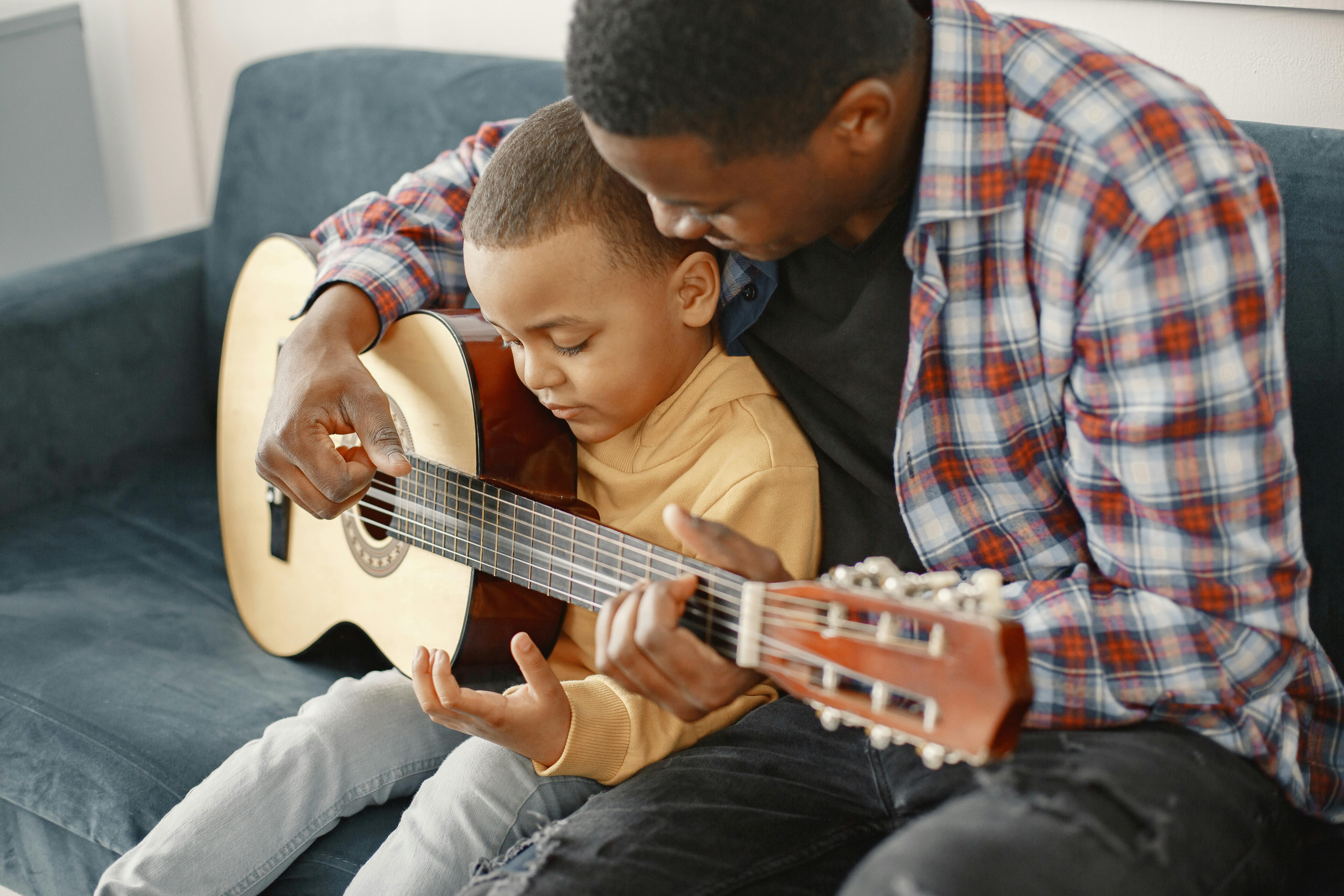
The other problem with parent-led teaching is the relationship cost. When a parent becomes a guitar teacher, the dynamic shifts in ways neither of them enjoys. Corrections start to feel like criticism. Practice sessions start to feel like homework with an audience. The child stops playing freely and starts performing for approval - which is the opposite of the internal motivation that sustains long-term skill-building. Even parents who are excellent musicians often find that their child learns faster, and more willingly, when the teaching comes from somewhere other than them.
What a Good Home Guitar Setup Actually Looks Like
Before thinking about method, the environment matters more than most parents realise. The right guitar for a child aged 6 to 13 is a properly sized acoustic or electric instrument - not a toy, not a three-quarter scale adult guitar that hasn't been set up correctly, and definitely not a plastic game controller. Music educators consistently emphasise that learning on a real instrument from the beginning builds genuine technique and ear training that no digital substitute can replicate. A child who spends six months on a toy guitar has not spent six months learning guitar - they have spent six months learning something that will need to be unlearned.
For most children under nine, a half-size or three-quarter classical guitar with nylon strings is the right starting point - nylon strings are easier on small fingers and the lower tension makes basic technique more accessible. For children who are already drawn to electric guitar sounds, a short-scale electric with light strings is a perfectly legitimate starting point, and often a better motivational fit. The goal is an instrument that does not fight back physically, so the child's attention can stay on the music rather than the discomfort.
Beyond the instrument, the single most important environmental factor is proximity. A guitar that lives in a case in a cupboard will not get played. A guitar on a stand in the living room - visible, accessible, slightly in the way - gets picked up. This sounds trivial, but it is one of the most consistently reported factors in whether a child builds a practice habit or doesn't.
The Feedback Problem - and Why It Is the Real Teaching Challenge
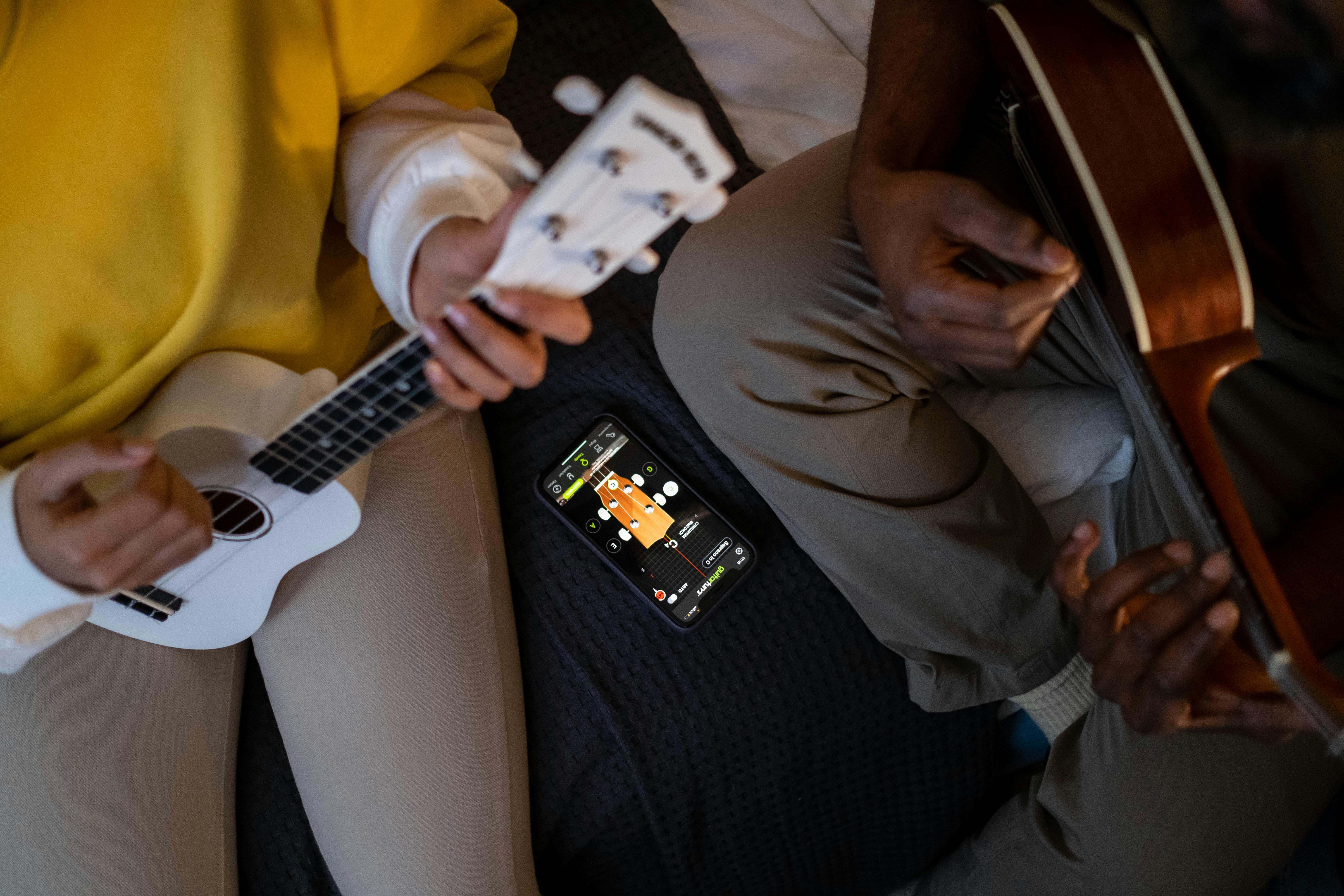
The hardest part of teaching guitar at home is not knowing what to teach. There is no shortage of content - YouTube alone has more free guitar lessons than any child could work through in a lifetime. The hard part is giving a child accurate, immediate feedback on whether what they just played was correct. Human ears, even trained ones, are not fast enough to catch every note in real time and respond before the child has moved on. And most parents teaching at home do not have trained ears at all.
This feedback gap is where most home guitar education breaks down. A child plays a chord, it sounds approximately right, the parent says "good job," and the child internalises a slightly wrong version of the technique. Over weeks and months, small errors compound into habits that are genuinely difficult to correct later. Research on skill acquisition in children shows that accurate feedback delivered immediately after an action is one of the strongest predictors of correct learning - not encouragement, not instruction, but precise, real-time correction at the moment the action happens.
This is why the most effective home guitar teaching in 2026 does not look like a parent sitting next to a child with a chord chart. It looks like a child engaging with a system that can actually hear what they are playing and respond to it instantly - while the parent's role shifts to something far more sustainable: encouragement, consistency, and showing up.
How Notey's World Solves the Problem Parents Can't
Notey's World is a video game that teaches real guitar - emphasis on game - built specifically for children aged 6 to 13. It is the part of home guitar teaching that most parents cannot do themselves: real-time audio feedback, immediate rewards, and a progression system that makes a child want to come back tomorrow without being asked.
The machine-learning audio engine listens to your child's real guitar in real time and responds to what they actually play. Sight-reading exercises become platformer levels. Kids earn Beatcoins by completing musical challenges, unlock character skins as they progress, and face boss-fights that test everything they have learned. The song library includes music children already love - Star Wars, Harry Potter, Disney hits, Sabrina Carpenter - which means the gap between "I want to learn guitar" and "I want to practice today" closes to almost nothing. That gap is where most children quit. Notey is designed to close it.
This is what changes the parent's role entirely. You are no longer the teacher, the enforcer, or the person who has to sit next to your child and correct their finger placement. You are the person who set up the right conditions - the right guitar, the right tool, a consistent time each day - and then stepped back. Notey holds a 4.7-star rating on the App Store and is used in NYC, Chicago, and Austin public schools, which is a meaningful signal that this is not just a clever concept but something that works in the hands of real children with real attention spans. You can explore Notey's World at notey.co - it is available on iOS and Android.
What Your Job Actually Is as a Home Guitar Parent
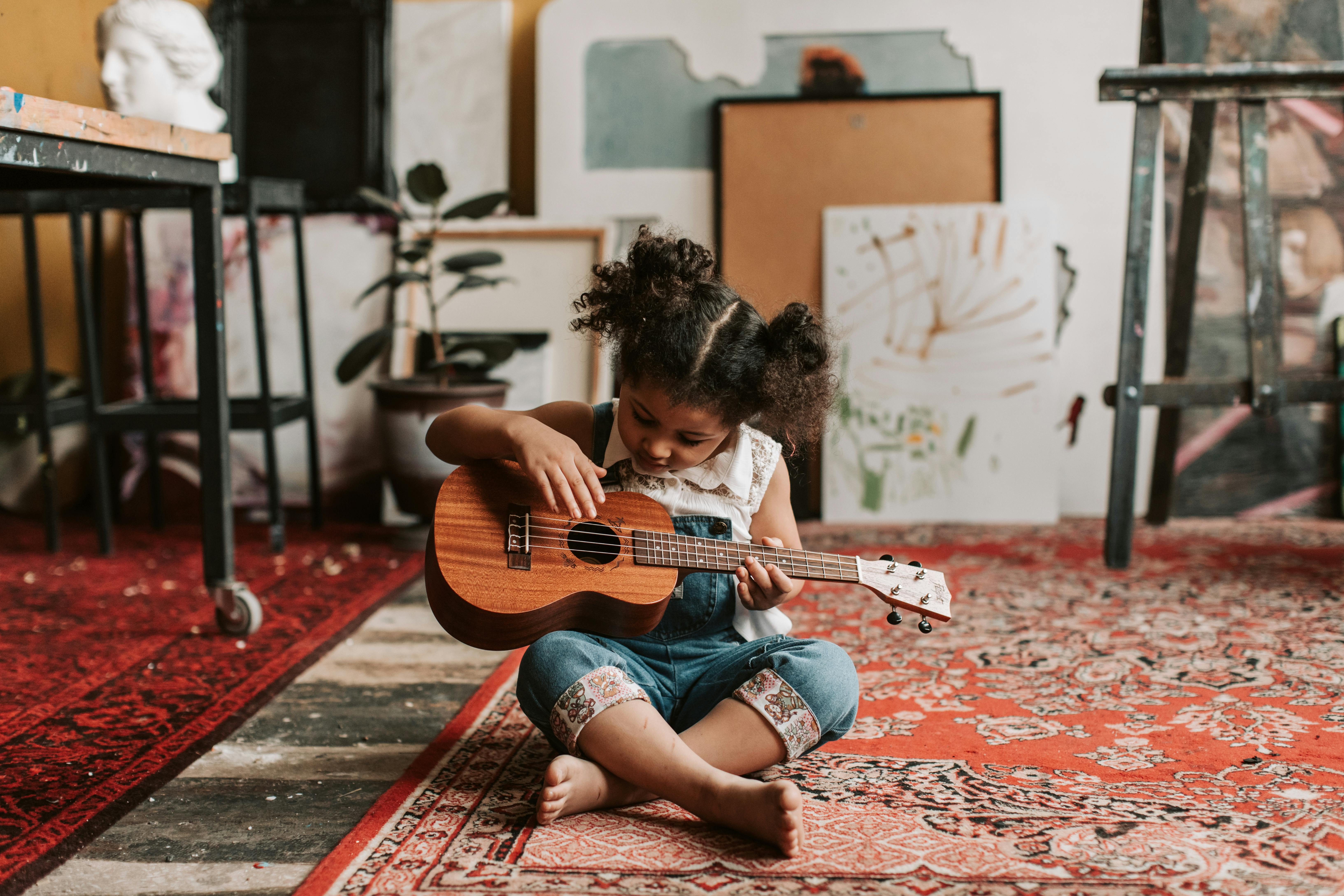
Once the right instrument and the right learning tool are in place, your job as a parent becomes much simpler - and much more enjoyable. The research on long-term music education is clear that parental involvement matters, but the kind of involvement matters enormously. Parents who sit in on practice sessions and offer corrections tend to produce children who quit earlier. Parents who express genuine interest, celebrate small wins, and play music around the house tend to produce children who keep going.
The single most valuable thing you can do is protect a consistent ten to fifteen minutes each day. Not an hour on weekends. Not "whenever there's time." A short, daily slot - same time, same place - that signals to your child's brain that guitar is a regular part of life rather than an optional activity. Habit research consistently shows that consistency of timing is a stronger predictor of habit formation than duration. Ten minutes every day will outperform an hour once a week, almost every time. If you want to go deeper on what to do when motivation dips - and it will - it is worth reading about what to do when your child wants to quit guitar, because knowing how to handle those moments in advance makes all the difference.
Guitar is one of the few skills that, once built at this age, tends to stay for life. The window when it can be built with the least resistance - when a child's brain is still fully wired to learn through play - is right now. The best way to teach a child guitar at home is not to teach them at all in the traditional sense. It is to create the conditions where they teach themselves, because they are having too much fun to stop.
Frequently Asked Questions
Can I Teach My Child Guitar at Home Without Knowing How to Play?
Yes. You do not need to play guitar yourself to support your child's learning at home. Your job is to create the conditions for practice - a good instrument, a consistent time, and a tool that provides real feedback. Apps like Notey's World use a machine-learning audio engine that listens to your child's guitar in real time, so the teaching happens automatically and accurately without you needing to be in the room.
How Long Should a Child Practice Guitar at Home Each Day?
For children aged 6 to 9, ten to fifteen minutes of focused daily practice is more effective than a single long session once or twice a week. Consistency matters far more than duration at this age. Short sessions that end before the child is tired or frustrated build the habit loop that sustains long-term progress - and they are far easier to maintain within a normal family routine.
What Is the Best Age to Start Teaching a Child Guitar at Home?
Most children are ready to begin learning guitar between ages 6 and 8, when fine motor skills and attention span are developed enough for short, structured practice. Starting earlier is possible with the right approach - shorter sessions, a properly sized guitar, and game-based learning tools that match a young child's natural way of engaging with new skills rather than asking them to sit still and follow instructions.