Can a 5 Year Old Learn Guitar? What Parents Need to Know

Yes, a 5 year old can learn guitar.
That is the direct answer - and it is worth saying it plainly, because a lot of what parents read online hedges so much that the message gets lost. Five-year-olds learn guitar successfully all the time. Some of the world's most accomplished guitarists started at this age or younger. The question is not really whether it is possible. The question is how to structure it so the experience stays positive long enough for real progress to happen.
Because there is a version of starting guitar at five that works beautifully, and a version that leads to frustration and a guitar gathering dust in the corner by Christmas. The difference between the two has almost nothing to do with your child's ability - and almost everything to do with the setup.
What 5 Year Olds Can and Cannot Do (Musically)
A five-year-old has a remarkable musical brain. Neuroscience research shows that children between the ages of three and seven are in a critical window for auditory development - their brains are actively building the neural pathways that underpin pitch recognition, rhythmic feel, and musical memory. Starting an instrument during this window does not just teach guitar; it shapes how the brain processes music for life. Early starters tend to develop stronger relative pitch and more intuitive rhythmic sense than those who begin later.
What five-year-olds cannot reliably do is sit still for forty-five minutes, tolerate abstract instruction, or work toward a goal they cannot see or feel. Traditional lesson formats - sitting across from a teacher, working through a method book, practising scales - were designed for older children and adults. Applied to a five-year-old, they are almost guaranteed to produce resistance. This is not a failing of the child. It is a mismatch between the format and the developmental stage.
Short attention spans at this age are not a bug - they are normal, healthy neurology. The solution is not to push through them but to design practice around them.
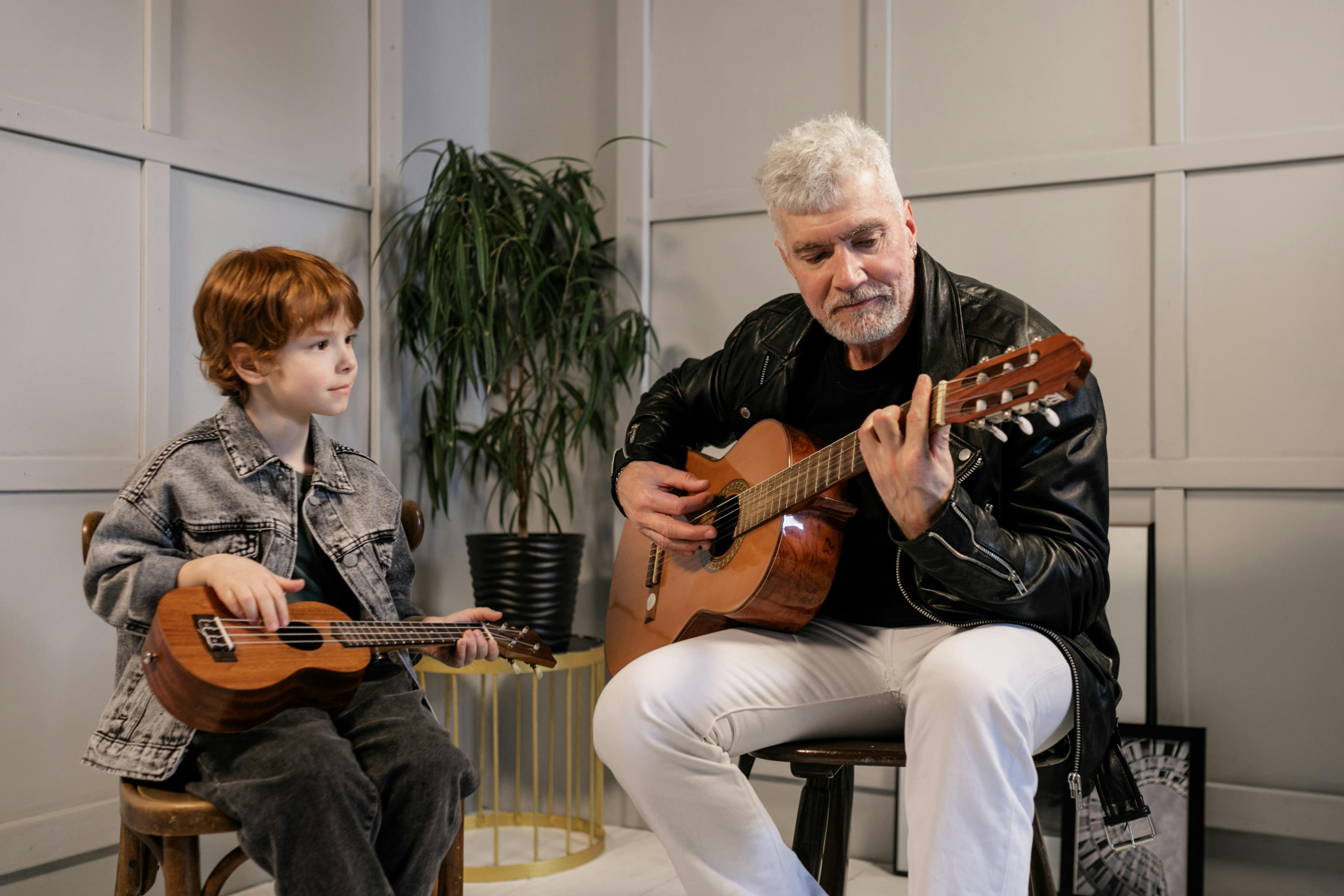
The Right Guitar Makes a Significant Difference
One of the most common reasons five-year-olds struggle with guitar is simply that they are holding the wrong size instrument. A standard full-size guitar is physically uncomfortable for a small child - the body is too wide, the neck is too long, and the stretch between frets becomes genuinely difficult for small hands. Starting on an ill-fitting guitar is like learning to write with a pen designed for an adult hand. The discomfort becomes the story, and the music gets lost.
For a five-year-old, a 1/4 size classical guitar with nylon strings is almost always the right starting point. Nylon strings are softer on fingertips than steel - which matters enormously in the early weeks, when fingertip sensitivity is the number one reason children want to stop. The 1/4 size fits naturally in small hands, making chord shapes achievable rather than frustrating. As your child grows, you move up to a 1/2 size, then a 3/4, and eventually a full size - each step feeling like a natural progression rather than a sudden leap. For more guidance on getting the setup right before lessons begin, our guide on what to do when your child says guitar is too hard covers the early physical hurdles in detail.
Session Length Is Everything at This Age
Forget the idea of a daily thirty-minute practice session for a five-year-old. It will not go well. The attention window for focused, effortful learning at this age sits closer to ten to fifteen minutes - and that is not a limitation to work around, it is a fact to design around. Two ten-minute sessions spread across a day are worth more developmentally than one twenty-minute session where the child has mentally checked out halfway through.
The goal at five is not volume - it is positive repetition. Each short session should end while the child still wants to keep going. That feeling of wanting more is the exact emotional state that builds the habit of returning to the instrument. The moment a session goes on too long and ends in frustration or reluctance, you have made the next session harder to start. Think of each practice like a chapter of a book a child loves: always stop before they are ready to put it down.
Songs They Know Beat Exercises Every Time
A five-year-old has no patience for playing exercises that sound like nothing. Their motivation is entirely tied to the connection between what their fingers do and a sound they recognise and love. This is why song choice at this age is not a nice-to-have - it is the primary driver of whether practice happens willingly or not.
Music education research consistently shows that emotional connection to repertoire is the strongest predictor of sustained practice engagement in young learners. A child who is working toward playing the Star Wars theme, a Disney song they love, or something they hear on the radio will practise with a focus and patience that no exercise can manufacture. Start with whatever they are currently obsessed with - not with what a method book says they should be playing.

Where Notey's World Comes In for Young Beginners
Notey's World is a guitar learning game for children aged 6 to 13, and it was built precisely to solve the problems that make early guitar hard for young learners. In Notey's World, sight-reading exercises become platformer levels, lessons are structured as missions, and children earn Beatcoins for completing challenges - a virtual currency they spend on character skins, unlocks, and new content. Boss-fights test what the player has learned and give each session the kind of momentum that makes a child want to come back tomorrow rather than be reminded to practise.
The song library includes music children actually want to play - Disney, Star Wars, Harry Potter, and contemporary artists - so the emotional connection that drives practice is built into the structure of the app itself. A machine-learning audio engine listens to the child's real guitar in real time and responds accordingly, meaning every level completed represents genuine skill on a real instrument. Notey holds a 4.7-star rating on the App Store and is used in NYC Public Schools, Chicago Public Schools, and Austin Public Schools, among others. Award-winning guitar educator Bill Swick has described it as a must-have for beginning guitar students - specifically because it uses a real guitar as a motivator rather than a plastic substitute.
For a five-year-old approaching six, Notey is worth having ready for the moment their hands are big enough and their interest is high enough to begin. The transition into structured, gamified learning at that stage tends to go smoothly - because the foundations of positive feeling around the guitar are already in place. You can read more about how that transition looks in our guide on how long it realistically takes kids to learn guitar.
The One Thing That Matters Most
If there is a single principle to take away from everything above, it is this: at age five, your job is not to produce a guitarist. Your job is to protect your child's relationship with the guitar long enough for them to want to become one. Every short session that ends happily, every song they recognise coming out of their own strings, every moment they pick up the guitar without being asked - those are the wins that matter right now. The technique will follow. The love of the instrument has to come first.
Five is not too young to start guitar. In many ways, it is a perfect time - provided the setup is right, the sessions are short, and the experience stays joyful. The children who eventually play for life are rarely the ones who practised the most at age five. They are the ones who never stopped wanting to.
Frequently Asked Questions
What Size Guitar Does a 5 Year Old Need?
A 1/4 size classical guitar with nylon strings is the standard recommendation for most five-year-olds. Nylon strings are gentler on soft fingertips than steel strings, and the smaller body and shorter neck make chord shapes achievable for small hands. As the child grows - typically around age seven or eight - they move up to a 1/2 size guitar.
How Long Should a 5 Year Old Practice Guitar Each Day?
Ten to fifteen minutes per session is realistic and effective for a five-year-old. Two short sessions spread across the day work better than one longer session. The most important rule is to end each session while the child still wants to continue - this keeps the emotional association with practice positive and makes the next session easier to start.
Should a 5 Year Old Take Formal Guitar Lessons?
Formal lessons can work at five, but only with a teacher who has specific experience teaching very young beginners. Sessions must be short, song-focused, and built around games and play rather than method books or scales. Many parents find that a combination of structured play at home and occasional teacher guidance works better at this age than weekly formal lessons alone.